Chasing in the Dark: The Cost of Invisible Property Chains
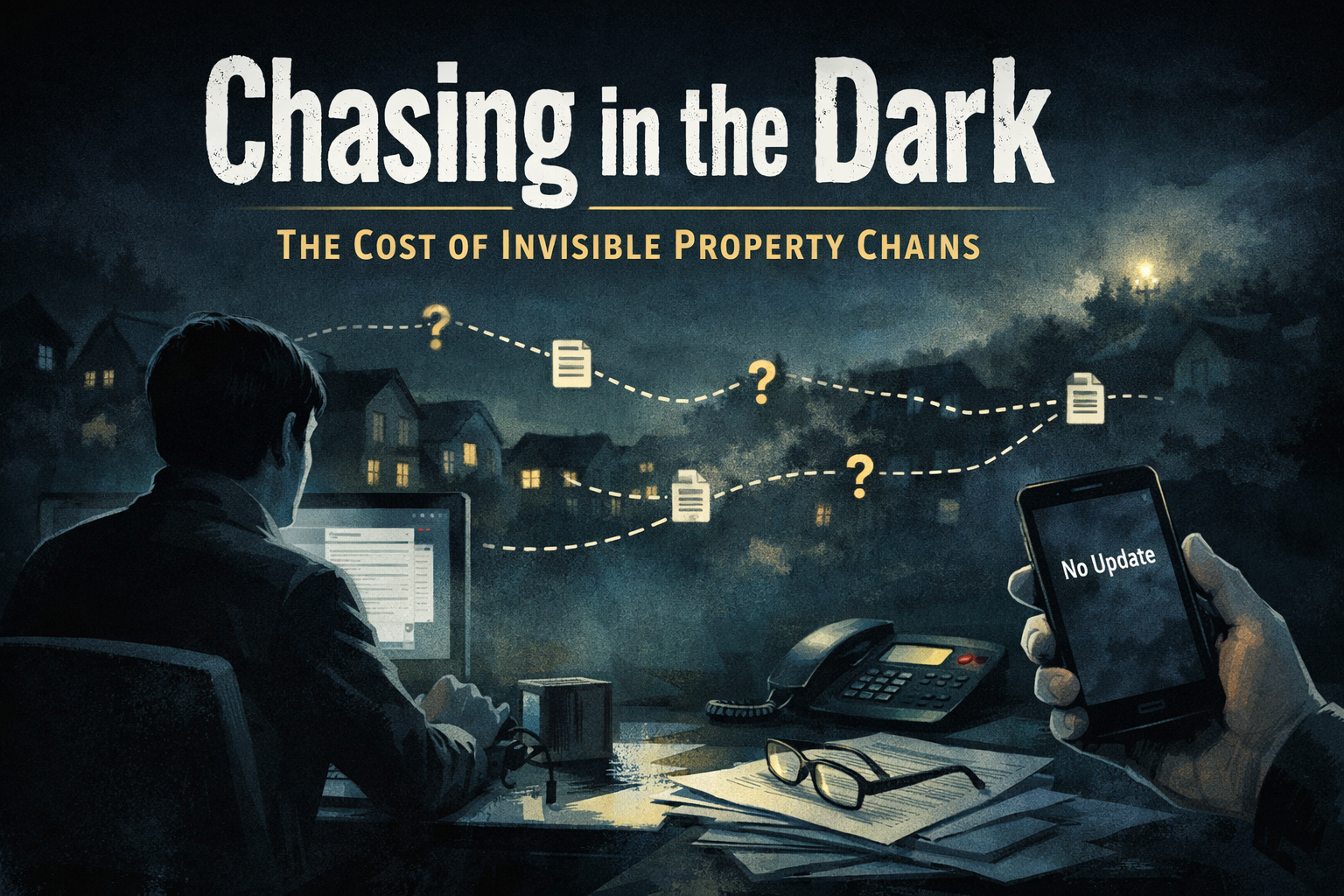
Chasing has become a defining feature of modern conveyancing.
Updates requested. Emails sent. Calls made. Follow-ups logged.
Each individual chase looks reasonable. Taken together, they form an operating model built on uncertainty.
This is not a productivity strategy. It is a coping mechanism.
How Chasing Became Normal
Chasing did not emerge because professionals became impatient or inefficient. It emerged because the system stopped providing shared context.
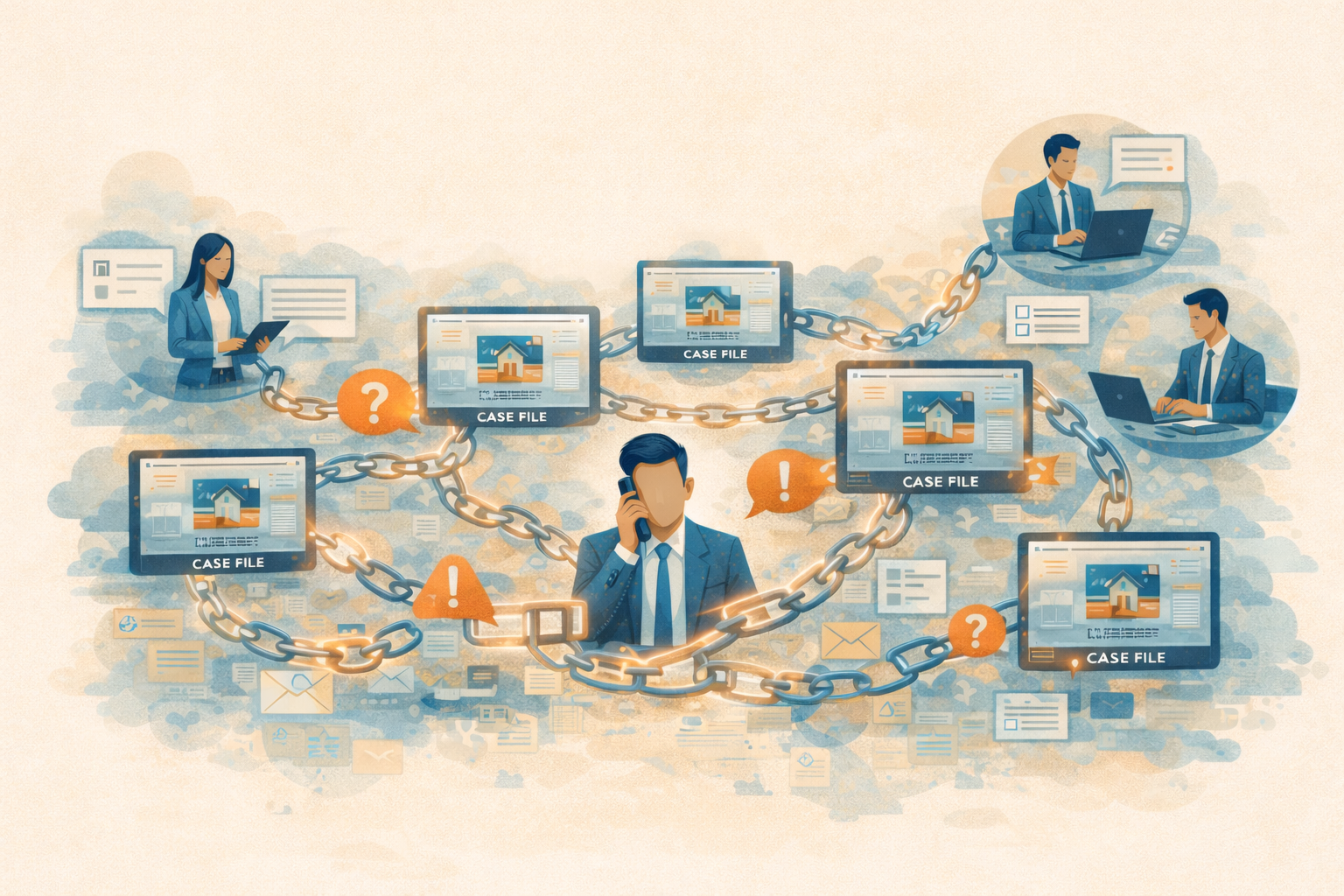
When no one can see what is happening elsewhere in the chain, the only way to find out is to ask. Repeatedly.
Over time, this behaviour hardens into habit. Roles appear whose primary function is to request updates. Workflows evolve around nudging, prompting, and checking in.
Blind coordination becomes normalised and is mistaken for diligence.
The Paradox of Modern Conveyancing
This is happening despite genuine progress elsewhere.
We now have digital identity checks, online searches, and milestone tracking. Tools that streamline individual transactions.
And yet the volume of chasing continues to rise.
Why? Because these improvements addressed transaction processing, not chain coordination. They made it easier to complete your own work. They did nothing to show whether that work matters.
Whether the chain you’re working in can actually complete — or whether effort is being expended on a transaction that will collapse three links away.
Better tools for individual files have not reduced chasing because chasing was never about individual files. It was always about the gaps between them.
What Chasing Is Actually Doing
Chasing does not create progress. It redistributes uncertainty.
Each request shifts pressure from one party to another without resolving the underlying constraint. In complex chains, this compounds quickly.
The result is a system full of duplicated effort, premature escalation, defensive file management, and constant interruption of legal work.
None of this improves outcomes. It simply makes uncertainty visible one message at a time.
A Better Model: Informed Pressure
A better model does not eliminate chasing.
It makes it intelligent.
When chain structure and status are visible, professionals can see which links genuinely control progress, pressure can be applied where it matters and withheld where it does not, and effort is focused instead of broadcast.
The conversation changes.
Instead of asking, “Can you update me?”
Professionals can ask, “This link is blocking exchange — what is needed to resolve it?”
That is not faster chasing. It is a different category of action.
The Real Cost of Blind Coordination
Blind chasing looks busy and feels responsive. But it carries hidden costs.
Time spent chasing is time taken away from judgement and decision-making. Frequent interruption increases error risk and encourages conservative buffering.
Most importantly, it obscures the real problem.
Uncertainty is treated as a communication failure, when it is in fact a visibility failure.
What Needs to Change
Chasing will always exist in conveyancing.
But the industry now has a choice.
It can continue feeding a system built on opacity, where coordination compensates for what infrastructure cannot show.
Or it can replace blind chasing with informed action, grounded in shared chain visibility.
The tools to do this now exist.
The question is whether the industry is ready to replace a habit that once compensated for opacity, but now entrenches it.