---
title: Why Chain Visibility Is Becoming Necessary in Conveyancing
description: Chain visibility is transforming conveyancing by reducing delays and failures, driving proactive management, and meeting evolving client expectations. Discover why it’s now essential for firms.
image: https://blog.viewmychain.com/hubfs/ChatGPT%20Image%20Jan%2016%2c%202026%20at%2009_11_17%20AM.png
---
[](https://viewmychain.com/)
[Login](http://app.viewmychain.com/) [Request a Demo](https://viewmychain.com/en-gb/book-a-demo)
- [Platforms](https://viewmychain.com/platforms)
- [Conveyancers](https://viewmychain.com/conveyancer)
- [Consumers](https://viewmychain.com/moveme)
- [Estate Agents](https://viewmychain.com/estate-agents/)
- [About Us](https://viewmychain.com/about-us/)
- [Meet The Team](https://viewmychain.com/meet-the-team)
- [Blog](https://blog.viewmychain.com/)
- [Contact Us](https://viewmychain.com/contact-us/)
- [Log In](http://app.viewmychain.com/)
[Request a Demo](https://viewmychain.com/en-gb/book-a-demo)
# Why Chain Visibility Is Becoming Necessary in Conveyancing
[Renu Kiran,](https://blog.viewmychain.com/author/renu-kiran) 19 January 2026

For decades, conveyancing in England and Wales has operated with an accepted blind spot: the property chain. That model is no longer holding.
Most conveyancers have a strong grasp of their own cases. What they lack is reliable visibility beyond them. Few firms know how long a chain is, where its vulnerabilities lie, or whether the transaction they are progressing depends on unresolved issues three properties away.
This is not a question of diligence. Case management systems are file-centric, not chain-centric. They track documents, milestones and tasks for an individual matter excellently. But they are blind to what is happening elsewhere in the chain. Conveyancers are expected to manage complex, interdependent transactions while having visibility of their own file and, at best, the immediate transactions directly above and below.
The consequences are measurable. Around one in three residential property transactions fails to complete each year. The chain itself – delays or collapses elsewhere that are not identified until late – is consistently cited as a primary factor. By the time a conveyancer learns that a linked transaction has fallen away, significant time and cost have already been incurred.
Time is spent progressing files that cannot yet move. Late-stage surprises trigger rework. Clients become frustrated. Fee recovery becomes contentious.
Professional expectations assume otherwise. Law Society guidance presumes an understanding of the chain in which a client sits. In practice, meeting that expectation is difficult when the chain itself is invisible. The result is a reactive system rather than a sequenced one.
Several developments are now making this untenable.
The government's Home Buying and Selling consultation identified chain visibility as an area for attention. If policy moves toward standardised chain data requirements – and the direction of travel suggests it will – firms that have already adopted chain visibility will have a material advantage.
Client expectations are shifting faster. Consumers track deliveries, flights and taxi drivers in real time. They cannot get a straight answer on whether the person at the top of their chain has instructed a solicitor yet. Firms without chain visibility cannot answer basic questions that clients now consider reasonable.
The gap between what clients expect and what most firms can deliver is widening. That creates reputational risk and competitive disadvantage.
Platform adoption is making the problem solvable. Chain data infrastructure now exists at scale across most UK residential transactions. What was previously impossible – knowing the status of linked transactions in near real-time – is now a question of adoption rather than capability.
The infrastructure works by aggregating milestone data from estate agents and conveyancers. It reconstructs property chains automatically. A conveyancer can see not just their own transaction, but the entire sequence it depends on: who has instructed, who has received searches, where mortgage offers are outstanding, which transactions are vulnerable.
This is not speculative technology. It is operational. The majority of UK chains are already visible to firms that have chosen to adopt it.
The implication is clear. Chain visibility is shifting from competitive advantage to table stakes. The question for conveyancing firms is no longer whether it will become standard practice, but whether to adopt it proactively or find themselves responding to a market that has already moved.
The firms that recognise this early are positioning themselves accordingly. Those that do not risk operating with a structural disadvantage that becomes harder to close over time.
## Related Articles
[](https://blog.viewmychain.com/chasing-in-the-dark-the-cost-of-invisible-property-chains)
[Conveyancing](https://blog.viewmychain.com/tag/conveyancing)
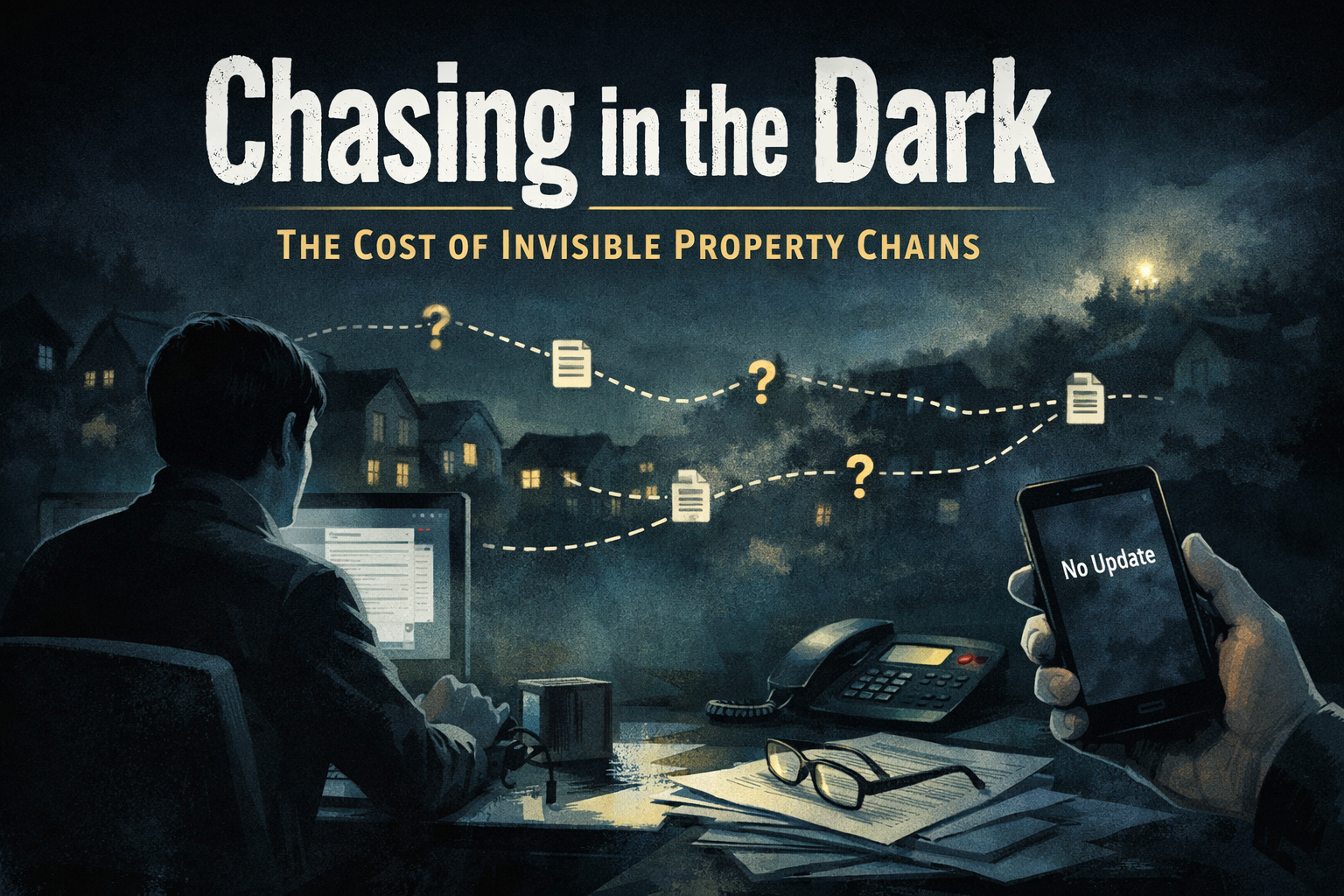
### [Chasing in the Dark: The Cost of Invisible Property Chains](https://blog.viewmychain.com/chasing-in-the-dark-the-cost-of-invisible-property-chains)
Chasing has become a defining feature of modern conveyancing.
[Renu Kiran](https://blog.viewmychain.com/author/renu-kiran)
[Read More](https://blog.viewmychain.com/chasing-in-the-dark-the-cost-of-invisible-property-chains)
[](https://blog.viewmychain.com/every-chain-has-a-weakest-link-the-hidden-bottleneck-in-uk-transactions)
[General](https://blog.viewmychain.com/tag/general)
### [Every Chain Has a Weakest Link: The Hidden Bottleneck in UK Transactions](https://blog.viewmychain.com/every-chain-has-a-weakest-link-the-hidden-bottleneck-in-uk-transactions)

[Paul Halliwell](https://blog.viewmychain.com/author/paul-halliwell)
[Read More](https://blog.viewmychain.com/every-chain-has-a-weakest-link-the-hidden-bottleneck-in-uk-transactions)
Everyone who's not using our software is talking about it.
[](https://blog.viewmychain.com/)
Back To Top
- [Estate Agents](https://viewmychain.com/estate-agents/)
- [About Us](https://viewmychain.com/about-us/)
- [Blog](https://blog.viewmychain.com/)
- [Contact Us](https://viewmychain.com/contact-us/)
- [Terms & Conditions](https://viewmychain.com/terms-conditions/)
- [Privacy Policy](https://viewmychain.com/privacy-policy/)
- [Home-mover Privacy Policy](https://viewmychain.com/home-mover-privacy-policy/)
- [Cookies](https://viewmychain.com/cookies/)
- [](https://www.facebook.com/viewmychain/)
- [](https://www.linkedin.com/company/view-my-chain-ltd)
- [](https://mobile.twitter.com/viewmychain)
© View My Chain Ltd. |
All Rights Reserved |
Patent Pending: UK application No. 1615855.2 |
8 Whittle Court, Knowlhill, Milton Keynes, MK5 8FT