Why Chain Intelligence Is Property’s Missing Smart Data Infrastructure


How Shared Visibility Can Transform the UK Property Market
The UK property market does not fail because people do not work hard enough. It fails because no one can see the whole picture.
The Challenge of Chains in UK Property
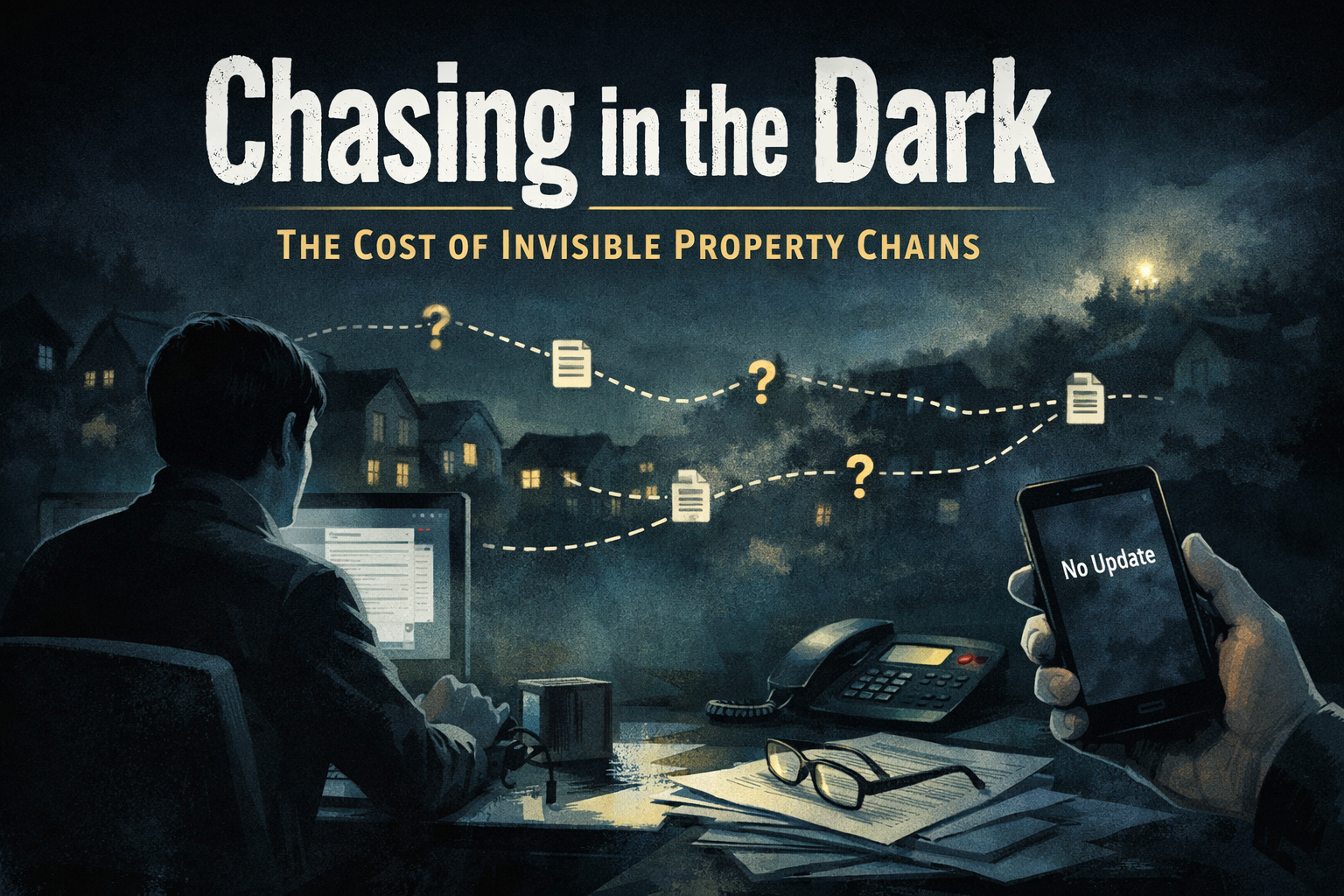
Around 55% of UK residential transactions sit inside chains. Buyers depend on sellers; sellers depend on onward purchases. Progress is dictated not by individual effort, but by the slowest or most fragile link elsewhere in the chain. Despite this being universally understood, chains remain largely invisible across the systems professionals rely on every day.
- Constant chasing
- Duplicated effort
- Stalled transactions
- Deals collapsing late for reasons that could have been identified much earlier
These issues arise not because the information does not exist, but because it is not shared in a usable way.
The Industry’s Response: More Tools, Same Problem
For years, the industry’s instinctive response has been to add more tooling: better CRMs, better workflows, better checklists. Each participant has optimised their own part of the process. Yet, chains do not live in any one part—they exist between organisations, between systems, and between incentives.
The Misdiagnosis at the Heart of Property Digitisation
Most digital transformation in property has focused on doing the same things faster: streamlining internal processes, reducing admin, improving visibility within individual firms. These improvements matter, but they miss the structural issue: property transactions are interdependent, but property systems are not.
No single agent, conveyancer, lender, or platform owns the chain. Each sees only a partial view, filtered through their own data and system boundaries. When progress stalls, everyone feels the impact—yet no one has authoritative visibility.
Trying to solve that with better tools inside silos is like trying to fix traffic congestion by upgrading individual cars. The bottleneck isn’t the vehicle. It’s the shared state of the road.
Lessons from Other Sectors
Other parts of the economy have faced—and solved—this problem:
- Finance: The breakthrough was standardised, permissioned access to account data, shared definitions, and machine-to-machine exchange. Once that infrastructure existed, innovation followed.
- Energy: Markets function because participants share a consistent view of meters, usage, and status—regardless of who the customer-facing provider is.
In both cases, success came from treating data as infrastructure, not as a competitive feature.
Property is the outlier—not because it is uniquely complex, but because it never built a shared data layer for the thing that matters most: the live state of the chain.
Property Needs Chain Intelligence
Property needs multiple infrastructure layers—standardised identifiers, milestone definitions, permissioned data flows. But chain intelligence is foundational because it captures the interdependency that defines how transactions actually work.
Chains Are Not a Feature—They Are Shared State
A property chain is not an enhancement or a convenience. It is the shared state of a transaction.
- Participants need to know whether a transaction is genuinely progressing.
- Conveyancers need to prioritise cases that can actually complete.
- Lenders need confidence that dependencies are stable.
- Buyers and sellers need certainty, not silence.
Yet chains are still reconstructed manually, through calls and emails, based on partial and often outdated information. Each party maintains their own version of the truth. That is the missing infrastructure layer.
Shared visibility changes behaviour. When progress is observable, everyone in the chain coordinates proactively.
Chain intelligence is not a communications tool, a workflow manager, or a consumer update feed. It does not replace professional judgement. It is a layer which sits between systems. It is permissioned, standardised, and continuously updated. It does not replace CRMs or case management systems—it feeds them. It allows different organisations to operate from the same underlying picture, even while using different tools.
Why This Is Becoming Inevitable
As property digitises, this gap becomes harder to ignore.
- Consumers expect transparency.
- Professionals struggle to prioritise effectively.
- Platforms are under pressure to reduce fall-throughs and transaction times.
- Standards, identifiers, and safer data sharing are becoming table stakes.
- Recent government consultations on Home Buying and Selling reform have recognised chain visibility infrastructure as a component of market improvement.
In that environment, chain intelligence stops being a “nice to have”. It becomes hygiene.
The question is no longer whether chains will be made visible in a standardised way, but where that capability lives. Inside every platform, duplicated imperfectly? Or once, as shared infrastructure that everyone can rely on?
History suggests the latter always wins.
Infrastructure Beats Tooling
The next phase of property digitisation will not be defined by who has the most features. It will be defined by who reduces friction across the whole system.
- Platforms that embed shared chain intelligence move faster because they are not constantly compensating for blind spots.
- Those that do not inherit delays and risk they cannot see or control.
This is not about replacing systems. It is about connecting them.
Where ViewMyChain Fits
ViewMyChain exists to provide that layer—a live, permissioned chain intelligence infrastructure that embeds directly into the systems people already use. Machine-to-machine, not screen-to-screen. Standardised, not bespoke.
Property has spent years optimising individual participants. The bigger opportunity now is to optimise the connections between them.
Chain intelligence is property’s missing Smart Data infrastructure. Mapping connected transactions and making it visible changes how the whole system behaves.
Further Information
This builds on ViewMyChain’s submission to the Home Buying and Selling Group consultation. If you are working on property platform integration or policy in this space, we welcome the conversation. Chain infrastructure raises interesting questions about standards, governance, and implementation that benefit from broader input.